
Fence cleaning
and staining.
A gray fence is almost never a dead fence. The silver you're looking at is UV-damaged surface fiber, usually less than a millimeter deep — and under it the cedar is generally fine. JHR cleans, restores, and stains existing fences across Dallas. Two visits, honest prep, and a finish that actually lasts.
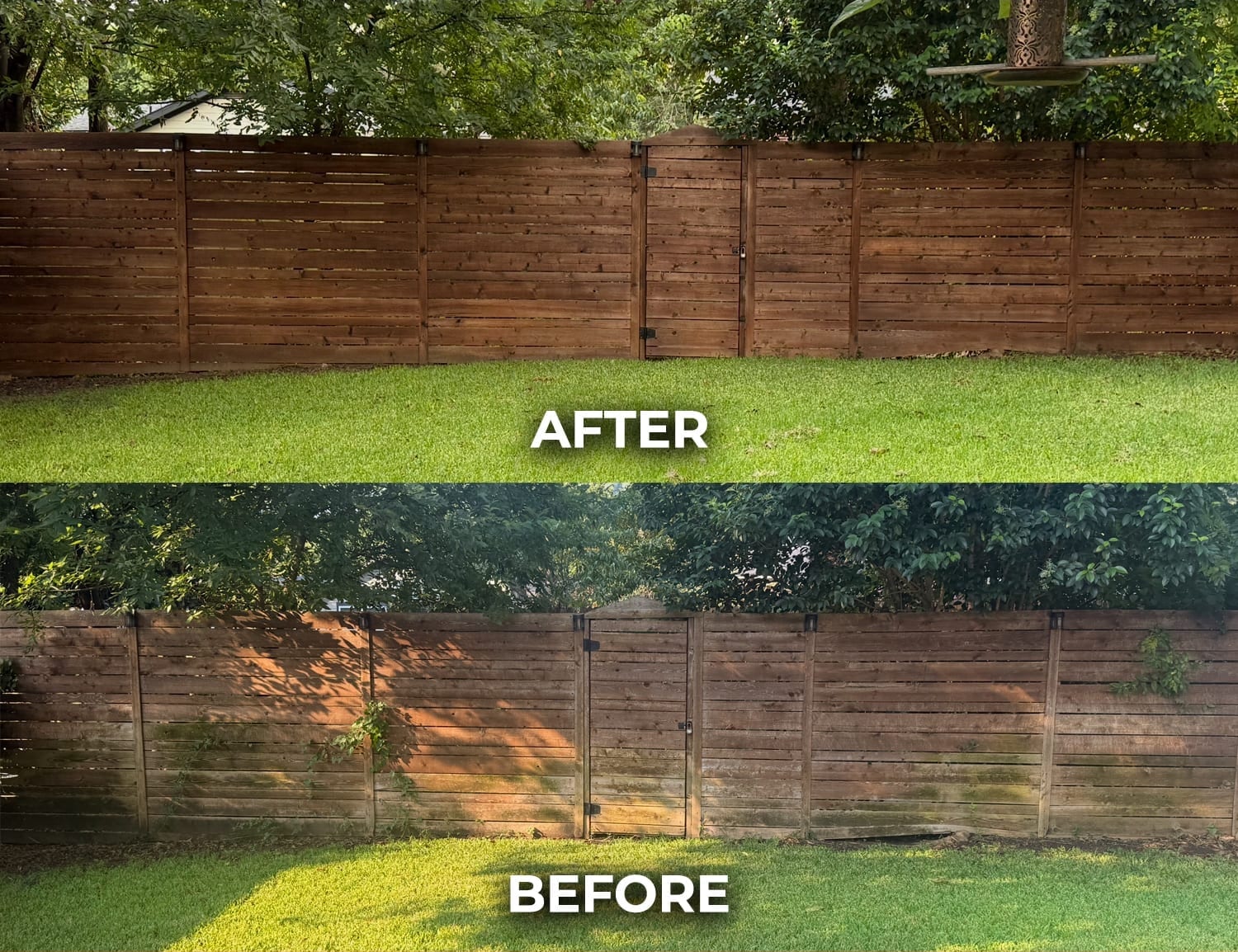
Most gray fences get replaced for no reason.
The default recommendation in this city is to tear it out. Usually that's wrong. Texas sun turns cedar silver in about two seasons, and sprinkler spray stipples the bottom rows with algae — both of those are finish problems, not wood problems. If the posts are solid and the boards aren't rotted, cupped, or split through, the fence doesn't need replacing. It needs the finish taken off and put back on.
A replacement is a five-figure conversation on a long run of fence. Cleaning and staining the same fence is a fraction of that, and when it's done right you get a decade out of it.
How a fence restoration actually runs.
- Algae and organic growth first. A bleach solution goes on wet and sits long enough to kill the growth at the root. Skip this and the green comes back through the new stain inside a year. It's the same reason you seal a water stain before you paint a ceiling.
- Pressure wash to bare fiber. The goal is to strip the dead gray fiber off the face of the boards without furring the wood underneath. Too much pressure opens the grain and the fence drinks stain unevenly forever after; too little and you're just coating the same tired cedar.
- Then it dries — and that's the part most jobs get wrong. Washing drives water into checks and end grain. Seal a film over damp wood and it blisters. The fence gets a moisture meter before anything goes on it, not a calendar date. In Dallas fall that's usually a day or two; sometimes it's longer, and I'd rather tell you that than come back to peeling.
- Stain, then back-brush. Spraying alone leaves lap marks and thin spots. Every pass gets worked back into the grain by hand, and the joints and post caps are cut in by brush.
Solid color or semi-transparent?
This is the one real decision and it's worth understanding before anyone quotes you.
Semi-transparent penetrates and lets the grain show. It's the better-looking option and it fails gracefully — it fades rather than peels. But it only works on bare or lightly weathered wood, and it can't cover an existing color.
Solid color is essentially thin exterior paint. It's opaque, it covers previous stain, and it's rated ten years. The tradeoff is that it forms a film, and films peel when they fail rather than fading. Which means the prep underneath it matters much more.
If your fence has never been stained, semi-transparent is usually the right call. If it has pigment in it already, you're going solid — there's no going back once color is in the wood, and anyone who tells you otherwise is about to do a job that fails.
Can you stain over a fence that already has oil stain on it?
Usually yes, and there's a test that settles it in ten seconds. Spray water on the boards. If it soaks in, the old finish has weathered down and a wash plus a wood cleaner gets you to a sound surface. If it still beads, the old stain is sealing and it has to come off with a stripper first — put a new coat over a surface that's still repelling water and it will peel, not fade.
If a stripper is used, the wood has to be neutralized with a cleaner afterward. Skipping the neutralizer is one of the quiet reasons a good-looking prep job still fails eighteen months later.
Fall is the window in Dallas.
October through early December is the right time to do this here. The wood is dry after summer, daytime temperatures sit in the range the finish actually wants, and humidity has dropped enough that a fence washed on Monday is ready by Wednesday. Mid-summer is too hot — the stain skins over before it penetrates. Deep winter, the fence never fully dries between the wash and the coat.
Which also means the calendar fills up in October. If you're thinking about it, now is the time to get on it.
What it costs.
Fence work is quoted flat-rate after I look at it, same as everything else at JHR. The number comes down to linear footage, whether we're staining one side or both, how much algae and organic growth has to be treated, and whether there's an old coating that needs stripping rather than just washing.
Send photos and the approximate length and I'll give you a real number, not a range that moves later. If a fence genuinely should be replaced rather than restored, I'll tell you that too — I'd rather lose the job than take your money for a finish over rotted boards.
What I don't do.
I don't install fences, set posts, or build new runs. This is restoration and finish work on fences that already exist. If you need a fence built, you want a fence contractor — and if you tell me what you're after I'll usually know someone.
Where I work.
The shop is at 2714 El Tivoli Dr. in Dallas, in Oak Cliff. Fence work runs across Dallas and the surrounding area — Oak Cliff, Bishop Arts, Kessler Park, Winnetka Heights, Lakewood, Highland Park, Park Cities, Richardson, Irving, and out toward Fort Worth. If you're on a street where a few neighbors are looking at the same tired fences, say so — a block usually prices better than a single run.
Send a photo of the fence.
A wide shot plus a close-up of the worst section is all I need to get started. Tell me roughly how many feet and whether you want one side or both.