
Mid-century modern furniture restoration.
A Dallas workshop dedicated to the restoration of mid-century modern pieces — Heywood Wakefield, Dillingham, Broyhill Brasilia, Paul McCobb, Lane Acclaim, Drexel Declaration, and the anonymous beautiful teak nobody tagged. Fifteen years of hand-rubbed finishes, custom toner matches, and structural repair that respects the maker.
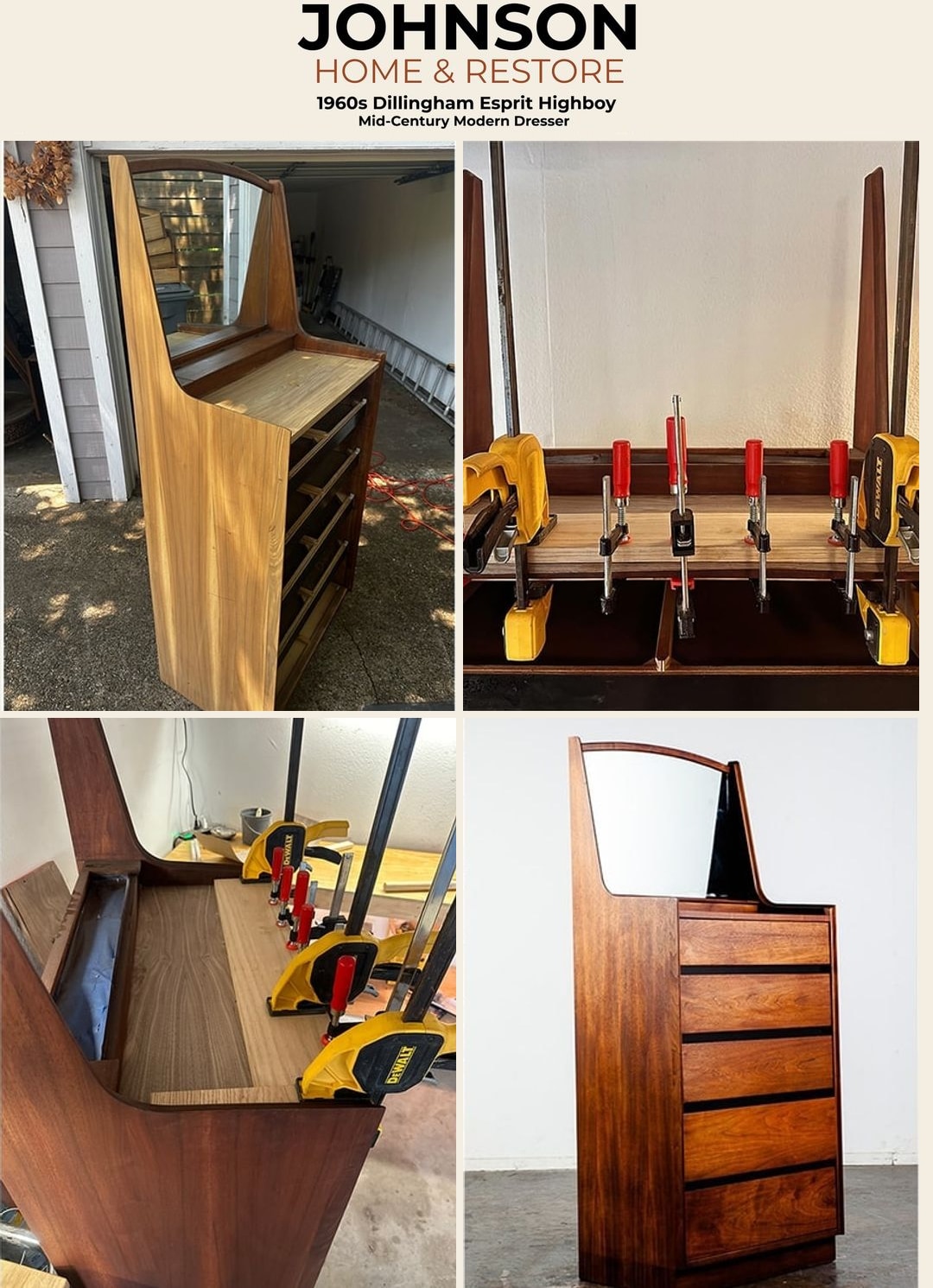
The right way to restore mid-century modern.
Mid-century furniture was designed at a peak. Domestic walnut, Heywood Wakefield birch, Lane's acclaimed teak laminates, Brazilian rosewood before it was CITES-restricted — these were materials chosen as carefully as the lines they'd be cut into. The finishes of the era, though, were products of their time: varnishes that ambered, lacquers that crazed, nitrocellulose clear coats that softened in the Texas heat.
The pieces that survive into 2026 have all been through something. Sun damage. Water rings. A kid with a marker. A refinish in 1987 that erased the original patina and replaced it with something glossy and wrong.
The job of a proper MCM restoration isn't to make a piece look new. It's to get back to what the designer intended — while respecting that the piece has actually lived. That means not sanding through veneer. Not blasting original patina off legs and aprons. Not using stock colors when the original finish called for a custom toner blend.
How a restoration runs at JHR.
- Evaluation. Every piece gets 20–30 minutes on the bench before a proposal. Veneer health, joint integrity, finish condition, hardware originality. What can be preserved, what has to be redone, what's worth keeping imperfect.
- Strip or preserve. Not every MCM piece needs a full strip. Sometimes a careful clean and recoat is the right move. When a full refinish is needed, the strip is chemical, not mechanical — to protect the veneer.
- Two-stage sanding. 120 then 180 grit, hand-blocked where the panel is flat and by hand where it isn't. Stops just short of the veneer line.
- Custom toner work. This is where most refinishes go wrong. Stock colors on MCM birch or walnut read cool or muddy. I mix TransTint blends to match the period and the piece — see the Aged Heywood Wheat recipe for one example.
- Hand-rubbed finish. Three coats of oil-based polyurethane, rubbed between coats with 0000 steel wool or pumice. The final surface feels right before you ever look at it.
- Hardware. Original brass reset and polished, or replaced with period-correct when originals are missing. Hinges tuned, drawer slides dialed.
- Delivery. Finished pieces wrapped, loaded, delivered. Inspected with the client before I leave.
What makes an MCM piece worth restoring.
Not every mid-century piece is worth the investment. An estate-sale lookalike made in 2003 won't return what a proper restoration costs. But a real Heywood Wakefield Wishbone table, a Dillingham Esprit, a Broyhill Brasilia cabinet, a McCobb Planner Group dresser — these are pieces where restoration adds value both on resale and in daily use.
If you're not sure what you have, send photos. I can tell you within a day what the piece probably is, what it's worth, and whether restoration makes sense — or whether you should leave it as-is, list it on Chairish, or keep it for another decade of honest patina.
Makers and periods I specialize in.
- Heywood Wakefield — Wheat, Champagne, Sable, Amber, Sahara. Custom Aged Heywood Wheat toner developed in-house for blending new parts to sixty-year patinas.
- Dillingham — Esprit and other domestic walnut lines. Structural repair and finish restoration.
- Broyhill Brasilia — the signature warm walnut tone requires careful toner work on raw wood.
- Paul McCobb — Planner Group, Directional, and Predictor pieces. Careful fidelity to the original look.
- Lane Acclaim — the distinctive two-tone walnut and oak; the oak work is where most refinishes go wrong.
- Drexel Declaration — Kipp Stewart designs, often needing veneer stabilization.
- Danish Modern — teak, rosewood, oiled finishes. Different philosophy, same standard of care.
- American Studio Craft — individual makers, one-off pieces, museum-grade work when warranted.
Where I'm located.
The shop is at 2714 El Tivoli Dr. in Dallas, in the Oak Cliff area. Pickup and delivery are included within 25 miles — Dallas, Oak Cliff, Park Cities, Highland Park, Lakewood, Plano, Richardson, Irving, Fort Worth. For pieces outside that radius, a flat travel add-on applies, and for significant pieces I'll travel almost anywhere in Texas.
What a restoration costs.
Every project is priced as a flat rate after evaluation. Full strip and refinish typically runs $1,200–$3,500 depending on size and complexity. Structural repair adds $300–$1,200. Custom color matching (like the Heywood Wakefield Wishbone apron job) is another $500–$2,000. Specialty finishes — marine-grade for outdoor pieces, wood bleach for water damage — sit in the $500–$1,800 range.
The proposal is always flat-rate and line-item, never hourly. You know what the job costs before I start. Standard terms: 50% at booking, balance on completion. Payment via Zelle, Apple Cash, Venmo, or card (3% fee on card).
Send photos. I'll scope it.
Any angle, any lighting. Close-ups of damage help. Tell me what you know about the piece — maker, provenance, how long you've had it — and I'll reply within one business day.